Microcar at 15 without a license: what to know first (age by country, 45 km/h, motorways)
At fifteen, in Spain, you can drive a microcar. It's the first real taste of freedom, and the first scare for parents. The rules, country by country, and how to be there without watching over them.

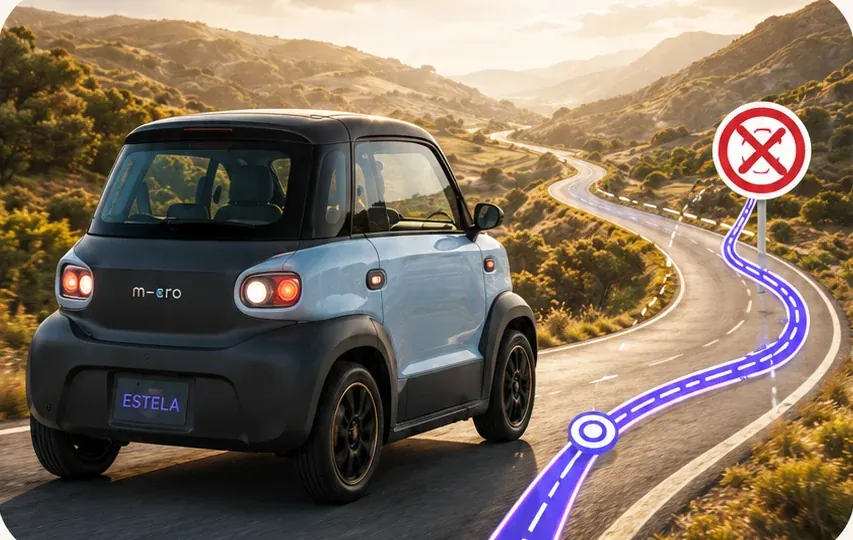
More and more microcars are showing up on Spanish streets, and plenty of them are driven by fifteen- and sixteen-year-olds. They're light quadricycles (L6e category): 45 km/h top speed, 425 kg, 6 kW, and no motorways or dual carriageways allowed. They're legal across the European Union; what changes from one country to another is the minimum age. Here's what we've checked against official sources, and then how to support a kid driving their first microcar without turning into their personal police officer.
The minimum age, country by country
These are the ages Mi Estela has checked against a source from each country (reviewed July 2026). When an age isn't confirmed, the app doesn't state it: this is guidance, not legal advice, and the rules change.
- Spain: 15 years old, AM license (DGT). 45 km/h, no motorways or dual carriageways.
- France: 14 years old, AM permit (“voiture sans permis”).
- Italy: 14 years old, AM license (“minicar”). Passengers aren't allowed until 16.
- Germany: 15 years old, Klasse AM (“Mopedauto”); at 15 the license is valid only within Germany.
- Portugal: 16 years old, AM license. National roads only.
- Netherlands: 16 years old, rijbewijs AM4 (“brommobiel”), with a practical exam.
- Switzerland: 18 years old, category F. Adults only.
- Sweden: there's no microcar; there's the A-traktor, a regular car limited to 30 km/h and registered as a tractor, from age 15.
Where it can't go (and why the navigator matters)
A microcar can't enter motorways or dual carriageways. A regular navigation app doesn't know that and will send you onto the M-40 without blinking. That's why the “Behind the Wheel” world in Mi Estela calculates a route designed for microcars: it knows which roads are banned by national regulation and avoids them. Local town ordinances are still being added, so road signs always take priority.
The first times
The first time alone, the first time at night, the first time in the rain, the first trip away. These are real milestones, and Mi Estela lets your kid be the one to mark them (“my first taste of freedom”) while your people cheer them on. It's not parental control: nobody receives anything they haven't chosen to share.
When they get stuck
A flat tire, a dead battery, out of fuel. “Something's wrong” sends their location to their people without triggering a rescue or making a drama. And if it's serious, SOS alerts the circle with their location and walks them through each step while help is on the way, with 112 (Spain's emergency number) one tap away, plus the emergency contacts they set up with the vehicle (insurance, garage). Mi Estela doesn't replace the emergency services.
The Pact behind the wheel
Parents want to know that their kid has left and has arrived. The kid wants not to be followed. The driving-safety Pact is mutual and out in the open: you both see exactly the same thing, nothing happens in secret. That's what keeps them from uninstalling the app a week later.
What we don't do
There are no speed reports or driving notes. A microcar goes 45; the app doesn't need to tell anyone that. Our line is being there, not judging. If what you're looking for is a driving report, other apps do that (Life360, for example); we deliberately don't.
Everything the app does with the microcar, the car and the motorbike is in Behind the Wheel.