Life360 sold location data: what to check before installing
In 2021 it came out that the world's biggest family app was selling its users' location data. What happened, what its policy says today, and how to check any app's policy in two minutes.


Location data is some of the most intimate information a phone generates: where you sleep, where you work, which doctor you visit, who you spend your nights with. And there's a market that buys it. This article covers the best-known case in the sector, with dates and sources, and ends with something useful: how to check in two minutes what any app does with your location.
What The Markup published in 2021
On December 6, 2021, the investigative outlet The Markup reported that Life360, the family location app with the most users in the world, was selling precise location data about its users to around a dozen data brokers, who in turn resold it. According to former employees cited in the investigation, those sales amounted to about $16 million in 2020, roughly 20% of the company's revenue that year.
What changed in 2022
On January 27, 2022, Life360 announced it would stop selling precise location data to data brokers. According to The Markup, it kept its agreement with Arity (a subsidiary of the insurer Allstate, for driving data) and the sale of aggregated data (to Placer.ai). In June 2023, a class action lawsuit over the data sales was filed in the United States.
What its policy says today
Life360's current privacy policy, last modified on August 26, 2026, says the company licenses "certain information, including precise geolocation" to selected partners for their own advertising and monetization purposes, with an option to opt out through "Your Privacy Choices." It also states that it doesn't show ads or sell data from accounts of users under 18. On the Spanish App Store listing, the app declares that it uses location, identifiers and contact data for third-party advertising. You can read it for yourself: the links are at the end.
We're not telling this to demonize anyone. Life360 is a legal app, with 102 million users, and it does many things very well. We're telling it because it's the clearest example that "family app" and "data-based business model" can go together, and that it's worth reading before you install.
How to check any app in two minutes
- The App Store or Google Play listing. Under "App Privacy" (Apple) or "Data safety" (Google), the company itself declares what data it collects and what for. Look for "precise location" next to "third-party advertising" or "tracking." If it's there, you know.
- The privacy policy. Look for the words "license," "partners," "monetization," "brokers," "aggregated." Not all of them mean the worst, but all deserve a read.
- The business model. If the app is free, what does it live on? If it has ads, it lives off your attention and sometimes off your data. If it has a subscription, it lives off the subscription. If it has neither, ask yourself.
- Where the servers are. Within the European Union, the GDPR applies in full.
What Mi Estela does (and how to verify it)
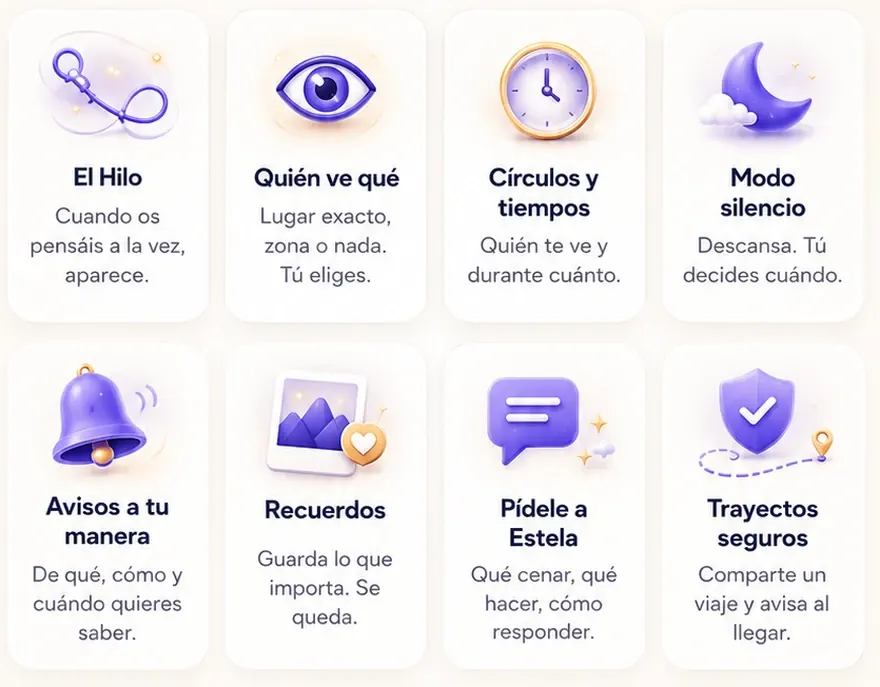
Mi Estela has no ads and does not sell or license location data to anyone: not to insurers, not to brokers, not in aggregate. It lives off the optional Premium subscription, paid per circle. The servers are in the European Union. Travel history is automatically deleted after 30 days, and each person decides whether to turn it on for whoever they choose. It's written in what Mi Estela will never do and in the privacy policy, and you can check it on the App Store listing. If it ever changed, it wouldn't be in fine print.
Sources
- The Markup: The Popular Family Safety App Life360 Is Selling Precise Location Data (Dec 6, 2021)
- The Markup: Life360 Says It Will Stop Selling Precise Location Data (Jan 27, 2022)
- The Markup: Life360 Sued for Selling Location Data (Jun 1, 2023)
- Life360: privacy policy (Aug 26, 2026)
- Spain App Store: Life360 listing (privacy)